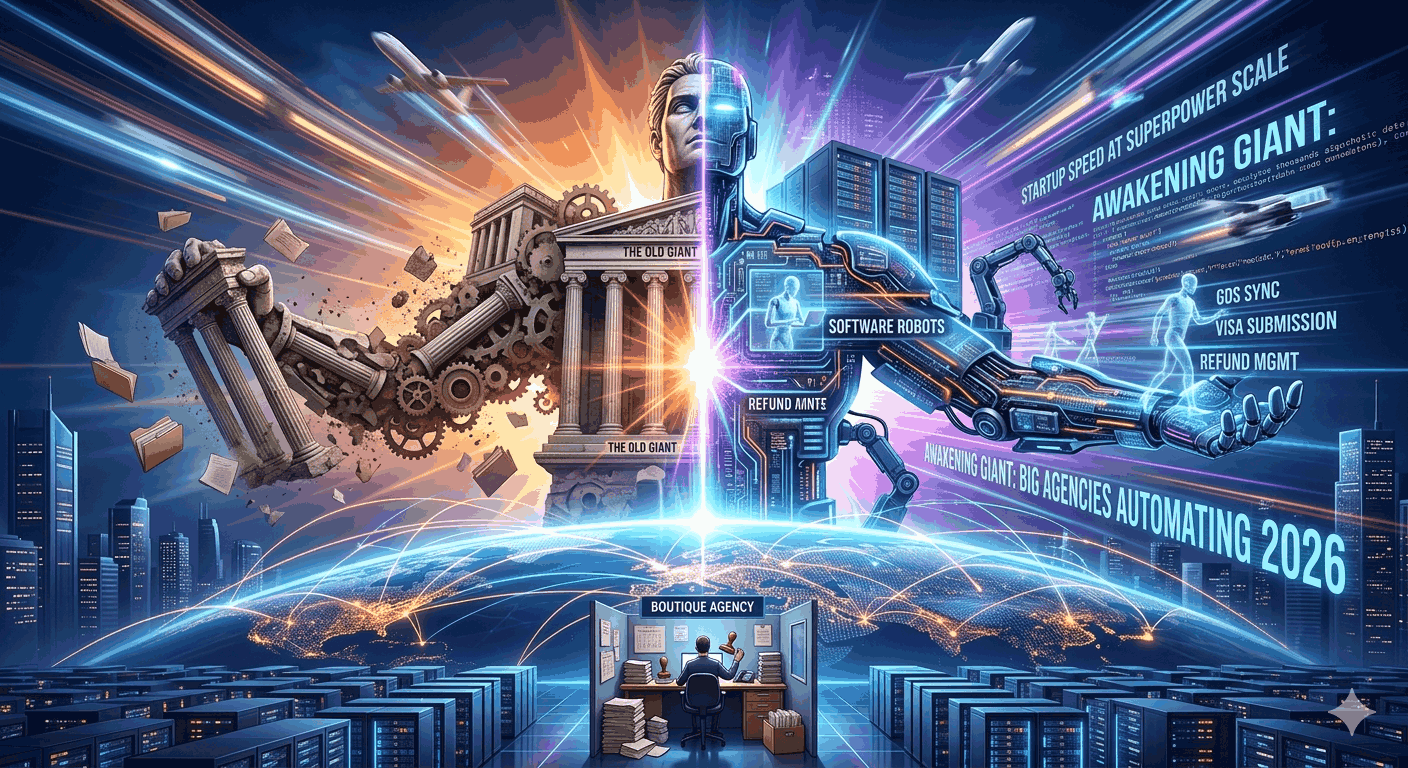
For a long time, the "Big Agency"—the global behemoths with thousands of employees—had a weakness: Bureaucracy. They were slow, monolithic, and often outmaneuvered by nimble boutique agencies that offered a "personal touch." But as we pass the midpoint of 2026, the narrative has flipped. The industry's giants have finally finished their digital transformations, and they didn't just digitize their files—they automated their DNA.
By integrating Enterprise-Grade AI and Agentic Workflows, the big players are now operating with the speed of a startup and the scale of a superpower. If you're a mid-sized or boutique agency owner, you aren't just competing with their marketing budget anymore; you're competing with their algorithmic efficiency. Here is how the big agencies are using automation to widen the gap.
1. The "Invisible Office": RPA and the 24/7 Backend
In 2026, the sun never sets on a major travel enterprise, but not because they have offices in every time zone. It's because of Robotic Process Automation (RPA). Big agencies have automated the "drudge work" that used to require massive back-office teams in low-cost centers. These "software robots" handle:
- ✈️ GDS Synchronization: Instantly updating flight changes and re-ticketing across thousands of bookings without a human touching a keyboard.
- 🛂 Visa Queueing: Automatically submitting digital visa applications to government portals the micro-second they open, ensuring their clients are always first in line.
- 💸 Refund Management: Scouring airline policies and processing thousands of tax-back claims that human agents often find too tedious to pursue.
🔑 Insider Insight:
The largest agencies have reduced their back-office headcount by 60% while increasing their transaction volume by 400%. They aren't firing people; they are reallocating them to high-value "Experience Design" roles.
2. Predictive Personalization (The "Netflix-ification" of Travel)
The big guys have a resource small agencies don't: Massive Data Pools. By 2026, they have refined the art of "Predictive Synthesis." While a small agent waits for a client to call, a Big Agency's AI has already analyzed the client's 2025 travel patterns, their recent LinkedIn promotion, and current currency fluctuations.
The Result: The client receives a push notification: "We've pre-cleared your business visa for the Dubai tech summit in October and held a business-class seat on your preferred airline. Click here to confirm."
By the time the client thinks about traveling, the Big Agency has already done 90% of the legwork. That isn't just service; it's prescriptive commerce.
3. Standardizing "The Human Touch" at Scale
The biggest challenge for a large agency used to be consistency. How do you make sure an agent in New York provides the same quality as an agent in Singapore? In 2026, big agencies use Real-Time Agent Assistance. As a human agent speaks to a client, an AI "co-pilot" listens in, instantly surfacing:
- ⚠️ Visa Compliance Alerts: "The client's passport expires in 5 months; they need a renewal for this specific route."
- 💎 Upsell Opportunities: "The hotel they like has a 2026 renovation special; offer the suite upgrade."
- 🧠 Sentiment Analysis: "The client sounds frustrated with the layover; suggest the direct flight instead."
| Feature | The Old Big Agency | The 2026 Automated Giant |
|---|---|---|
| Response Time | 24 - 48 hours | < 30 seconds (via AI Agent) |
| Error Rate | 5–8% (Human error) | < 0.1% (Algorithmic check) |
| Cost per Booking | High (Heavy Labor) | Ultra-Low (Fixed Tech Cost) |
| Client Retention | Hit-or-Miss | High (Data-driven loyalty) |
4. The Aggressive Acquisition of "Niche Knowledge"
Big agencies are no longer just buying other agencies for their client lists; they are buying them for their Logic. If a boutique agency has a "secret sauce" for getting O-1 visas for artists, big agencies are now using AI to "scrape" and codify that expertise into their central brain. Once that niche knowledge is digitized, the big agency can offer that specialized service to 100,000 people overnight, effectively commoditizing what used to be a high-priced boutique specialty.
The Boutique Counter-Strike: How to Survive
If the big guys are becoming automated machines, how does a smaller agency survive? You don't beat them at scale; you beat them at Depth.
- 🤝 Own the "Un-automatable": AI can book a flight, but it can't walk into a boutique hotel, know the owner by name, and ensure your client gets the room with the best view of the Eiffel Tower because of a personal favor.
- 🎯 Hyper-Specialization: Be the absolute world authority on one tiny thing. Automation thrives on "General Rules." It struggles with the "Exception to the Rule."
- ⚡ Adopt "Lite" Automation: You don't need a million-dollar dev team. In 2026, off-the-shelf AI agents are available to small businesses. Use them to handle your own "drudge work" so you can get back to being human.
Final Thoughts
The era of the "Lazy Giant" is over. The big agencies of 2026 are lean, mean, and powered by silicon. They have turned travel into a high-speed data game where the winner is the one who can remove the most friction for the lowest cost.
For the rest of the industry, the message is clear: Automate the routine, so you can humanize the remarkable. If you spend your day doing what a 2026 script can do for $0.05, your days are numbered. But if you use that script to give yourself the "superpowers" of a giant, the future is yours for the taking.