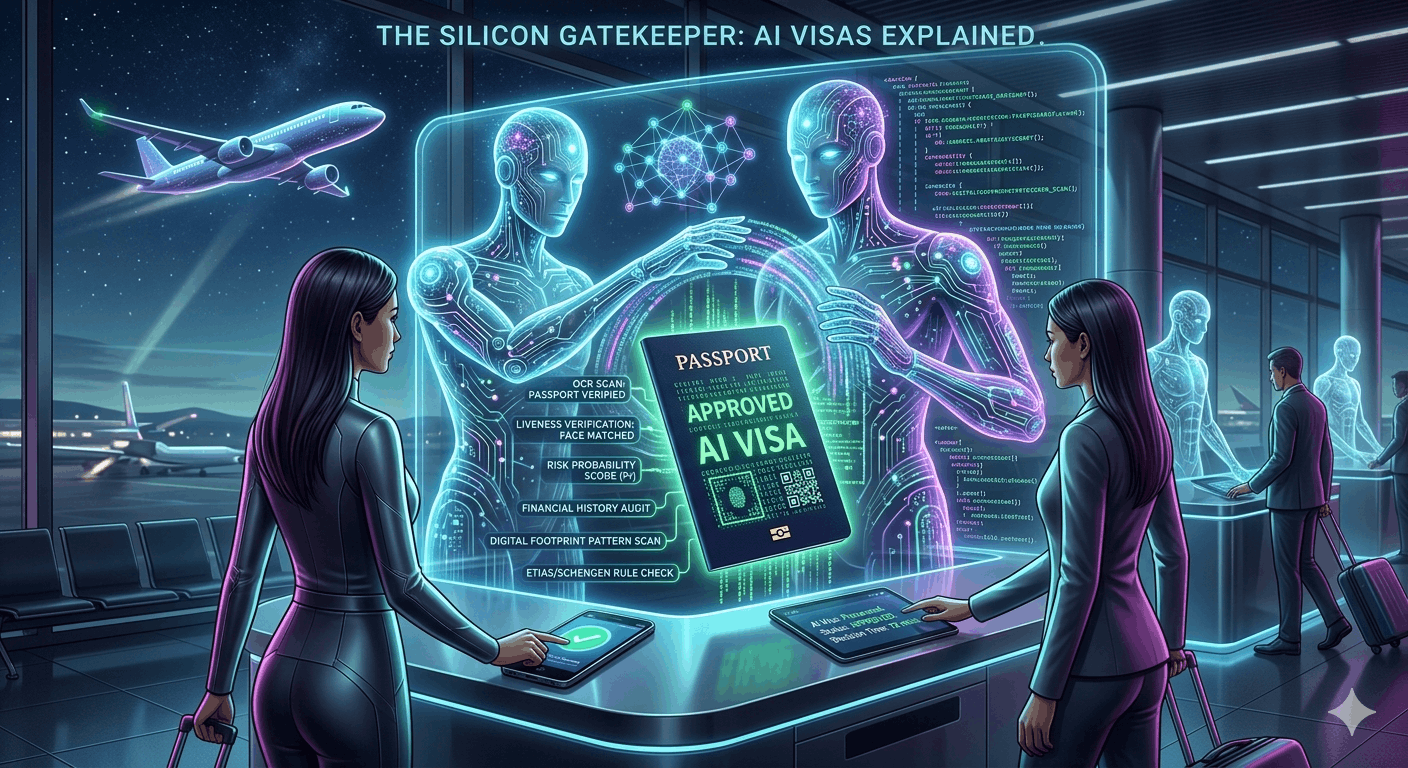
If you’ve applied for travel authorization in the last six months, you’ve likely noticed something eerie. There were no long lines at an embassy. No grumpy officials peered over their spectacles at your bank statements. Instead, you uploaded a few photos, waited a few minutes, and received a digital "Approved" notification while your coffee was still hot.
Welcome to the era of the AI Visa.
By 2026, the global immigration landscape has undergone a silent coup. The rubber stamp has been replaced by the neural network. But how exactly does a machine decide if you’re "fit" to cross a border? Let’s pull back the curtain on the algorithms that now guard the world’s gateways.
1. The Anatomy of an AI Visa Process
An AI Visa isn't just a digital form; it's a high-speed data synthesis. When you hit "Submit," a series of autonomous agents begin a process known as "Immigration Forensics."
Stage A: The Optical Audit (OCR)
The moment you upload your passport, an Optical Character Recognition (OCR) engine deconstructs it. It
isn't just reading your name; it is checking the typography, the micro-print, and the holographic depth
against a global database of forged documents. It cross-references your MRZ (Machine Readable Zone) with
the data in your chip.
Stage B: The Risk Synthesis
This is where the actual "intelligence" happens. The system calculates a Risk Probability Score
(Pr) based on hundreds of variables. In a simplified model, the logic looks like this:
Pr = (Σ (Vs + Fh + Ct)) / Nd
Where:
- Vs = Validity of Sponsorship/Accommodation.
- Fh = Financial History stability.
- Ct = Cross-border travel consistency.
- Nd = National Security Database alignment.
2. Beyond Human Eyes: What the AI Sees
Unlike a human officer who might be swayed by a well-written cover letter, AI is looking for patterns in the "noise." In 2026, immigration AI analyzes:
- 👤 Liveness Detection: When you take that mandatory selfie, the AI is looking for blood flow patterns and micro-reflections to ensure you aren't a high-quality deepfake or a static photo.
- 🌐 Digital Footprint Correlation: Many jurisdictions now use AI to scan public digital footprints. If your visa says "Tourism" but your recent public posts discuss "looking for a flat in Berlin," the system flags an Intent Discrepancy.
- ⏳ The 90/180 Rule Automation: The AI tracks your movement across visa-free zones (like the Schengen Area) with decisecond accuracy, ensuring you haven't overstayed by even an hour in the last six months.
| Feature | Traditional Visa (2020) | AI Visa (2026) |
|---|---|---|
| Primary Reviewer | Consular Officer | Algorithmic Agent |
| Decision Time | 5 - 15 Business Days | 2 - 15 Minutes |
| Error Rate | 5% (Human Fatigue) | < 0.01% (Logic Based) |
| Data Sources | Provided Documents | Real-time API Integrations |
3. The "Computer Says No": Navigating Algorithmic Rejection
The biggest fear in 2026 is the "Black Box Rejection." Because AI processes data so quickly, it can be cold. A simple data mismatch—like a hotel booking that was cancelled after you submitted the application—can trigger an instant refusal.
Pro Tip: In the AI era, consistency is more important than charisma. The machine doesn't care if you're a nice person; it cares if your data points align across every database it touches.
If you are rejected by an AI, the "appeal" process has also changed. You are no longer arguing with a person; you are providing "Corrective Data" to satisfy the algorithm's missing logic. This is why many travelers now use AI Visa Consultants—software that "pre-audits" their application to ensure it meets the algorithm’s hidden thresholds.
4. The Ethical Tightrope: Bias and Privacy
We have to be candid: AI is only as good as its training data. There is ongoing debate in 2026 regarding "Algorithmic Bias." If a system is trained on historical data that was biased against certain demographics, the AI might inadvertently replicate those prejudices in its risk scoring.
Governments are countering this with Explainable AI (XAI). By law in many regions, the system must now provide a "Reason Code" for every rejection, allowing humans to audit the machine's logic.
5. Why You Still Need a "Human in the Loop"
You might think that in a world of AI visas, travel agents are obsolete. Actually, the opposite is true. Because the AI is so unforgiving, the role of the travel expert has shifted from "Form Filler" to "Compliance Architect."
A human expert understands the nuance that a machine misses. They can advise you on how to present a "Digital Nomad" lifestyle to a system that was built for "9-to-5" employees. They are the ones who can bridge the gap between your messy, human life and the machine’s rigid binary requirements.
Final Thoughts: Embracing the Invisible Border
The AI Visa isn't just about speed; it’s about a world that is becoming more connected and more monitored simultaneously. While the 15-minute approval feels like magic, it’s a magic built on total transparency.
As we move forward in 2026, the key to global mobility is simple: Data Integrity. If you keep your digital house in order, the silicon gatekeepers will swing the doors wide open. If not, you might find yourself locked out by a line of code you never even knew existed.