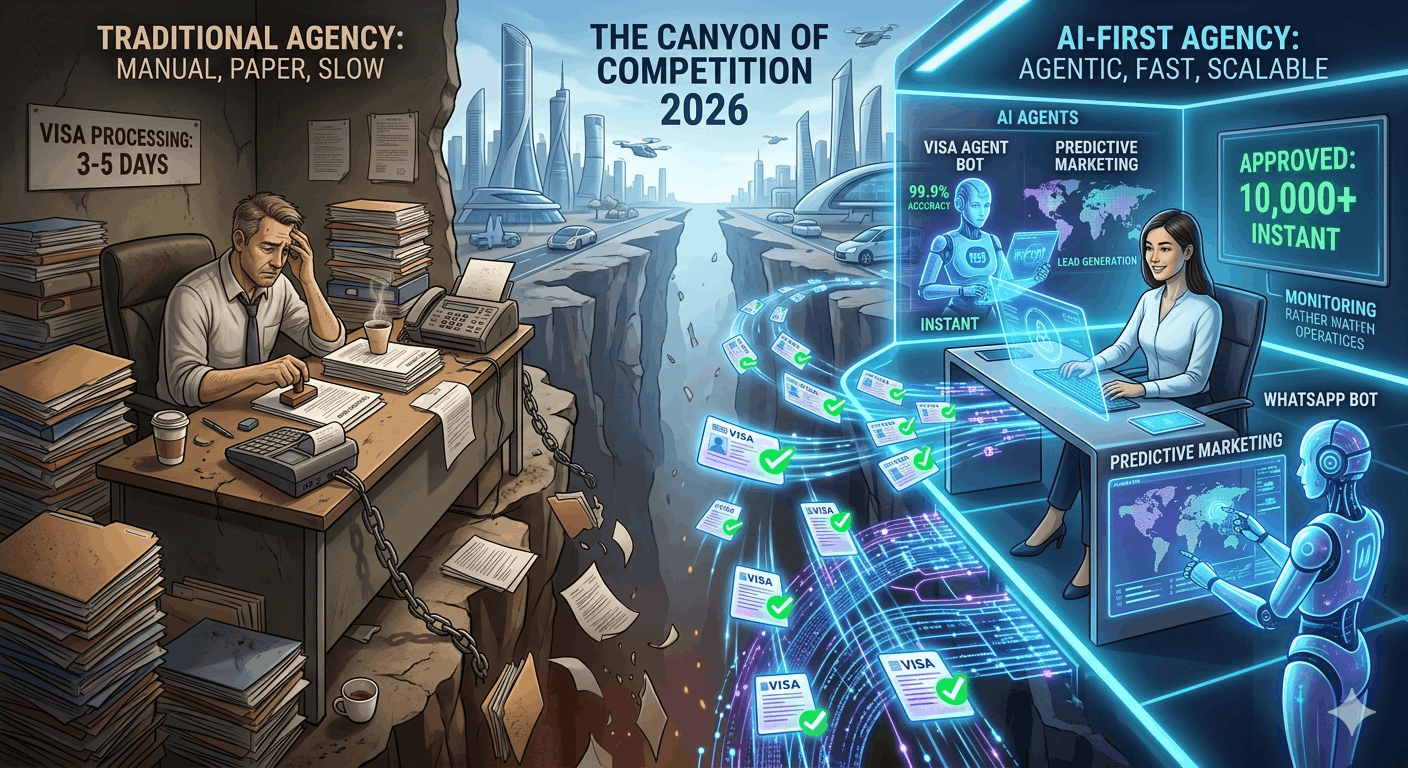
For decades, the travel industry was a "relationship business." You competed on the strength of your handshake, the depth of your destination knowledge, and the speed of your fax machine. But as we move through 2026, a new type of competitor has entered the arena. They don’t have a physical office, they never sleep, and they can process a thousand visas before you’ve finished your morning coffee.
If you feel like your "loyal" clients are drifting away or your lead volume is dropping, it isn't just "the market." It’s likely that your competitors have stopped being just travel agents and have started being AI-augmented enterprises.
The gap between the "Traditional Agent" and the "AI-First Agency" is no longer a crack; it’s a canyon. Here is exactly how your competitors are using AI to eat your market share.
1. The "First to Respond" Advantage
In the 2026 economy, the agency that answers first wins the booking. While you are manually sorting through emails at 9:00 AM, your AI-powered competitor has already "closed" three clients who inquired at 2:00 AM.
Your competitors are using Agentic AI—autonomous systems that don't just send a "we received your message" auto-reply. These agents:
- Qualify the Lead: They ask the right questions about travel dates, budget, and visa history.
- Handle Objections: They can explain the new 2026 ETIAS requirements or the nuances of the Digital Schengen system instantly.
- Book the Consult: They link directly to the agent's calendar or, in some cases, collect the deposit on the spot.
The Competitive Edge Formula: E = (A × S) / F
Where E is your Competitive Edge, A is Accuracy, S is Speed, and F is Friction. Competitors using AI are driving F to near-zero, making their edge theoretically infinite compared to manual shops.
2. Perfection as a Service (The Zero-Error Model)
In the past, an agent’s "attention to detail" was their selling point. In 2026, human attention is a liability. Your competitors are using OCR (Optical Character Recognition) and LLM-driven compliance engines to ensure that every document is perfect before it ever reaches a consulate.
While your team is squinting at a blurry passport scan to check for an expiration date, your competitor’s system has already:
- Verified the passport against 2026 global databases.
- Auto-filled the application form with 100% accuracy.
- Flagged a potential "Intent Mismatch" in the client's cover letter that would have led to a rejection.
By the time the application is filed, it has been "vetted" by a machine that has seen millions of successful applications. This allows them to offer "Approval Guarantees"—a marketing hook that a manual agent simply cannot afford to match.
3. The Scalability Gap: 1 Agent vs. 1,000 Agents
This is the most painful realization for traditional agency owners: Your competitors have effectively cloned their best employees.
By using AI, a single human consultant at a modern agency can manage a volume of clients that would traditionally require a staff of twenty.
- Bulk Processing: When a corporate group of 500 needs visas for a tech summit in India, the AI-First agency handles it in minutes.
- Personalized Follow-up: The AI tracks every client's "Visa Anniversary," automatically reaching out six months before a multi-year visa expires to offer a renewal service.
| Metric | Traditional Agency | AI-First Agency |
|---|---|---|
| Max Clients per Staff | 20 - 30 per month | 150 - 200 per month |
| Average Response Time | 4 - 6 Hours | < 30 Seconds |
| Data Entry Error Rate | 3% - 5% | < 0.01% |
| Operating Margin | 10% - 15% | 40% - 55% |
4. The Myth of the "Personal Touch"
The most common defense from traditional agents is: "But my clients want to talk to a human." In 2026, that is only partially true. Clients want to talk to a human for complex strategy, emotional reassurance, and high-value curation. They do not want to talk to a human to check if their PDF was received or to ask what the current visa fee is.
Your competitors understand this. They use AI to handle the "commodity" interactions, which frees up their human staff to spend more time on high-value relationship building.
- You are busy filling out forms.
- They are having a 30-minute coffee with a VIP client to plan their 2027 world tour.
The AI doesn't replace the personal touch; it subsidizes it.
5. Predictive Marketing: Finding Leads Before They Exist
If you are waiting for the phone to ring, you’ve already lost. Your competitors are using Predictive Analytics. By analyzing flight search patterns, LinkedIn job changes, and historical travel data, their AI identifies people who are likely to need a visa in the next 60 days. They then target these individuals with hyper-specific ads or emails: "Planning that move to Portugal? The 2026 D7 rules just changed—here is our automated checklist."
They aren't just better at selling; they are better at finding.
How to Close the Gap
The good news? The same tools your competitors are using are becoming increasingly accessible to boutique agencies. You don't need a $1 million R&D budget in 2026.
- Stop Manual Filing: Use white-label platforms that offer AI document verification.
- Integrate an AI Agent: Deploy a specialized travel agentic bot on your WhatsApp and website to handle the "Top of Funnel" 24/7.
- Data-Clean Your CRM: Feed your client history into an AI tool to identify who is due for their next trip.
Final Thoughts
In 2026, AI is no longer a "future trend." It is the current operating system of the travel industry. Your competitors aren't necessarily smarter or more experienced than you—they just have a more powerful engine under the hood.
If you continue to run your business with "manual labor" as your primary resource, you are bringing a knife to a drone fight. It’s time to upgrade your tech stack before your competitors upgrade your clients.