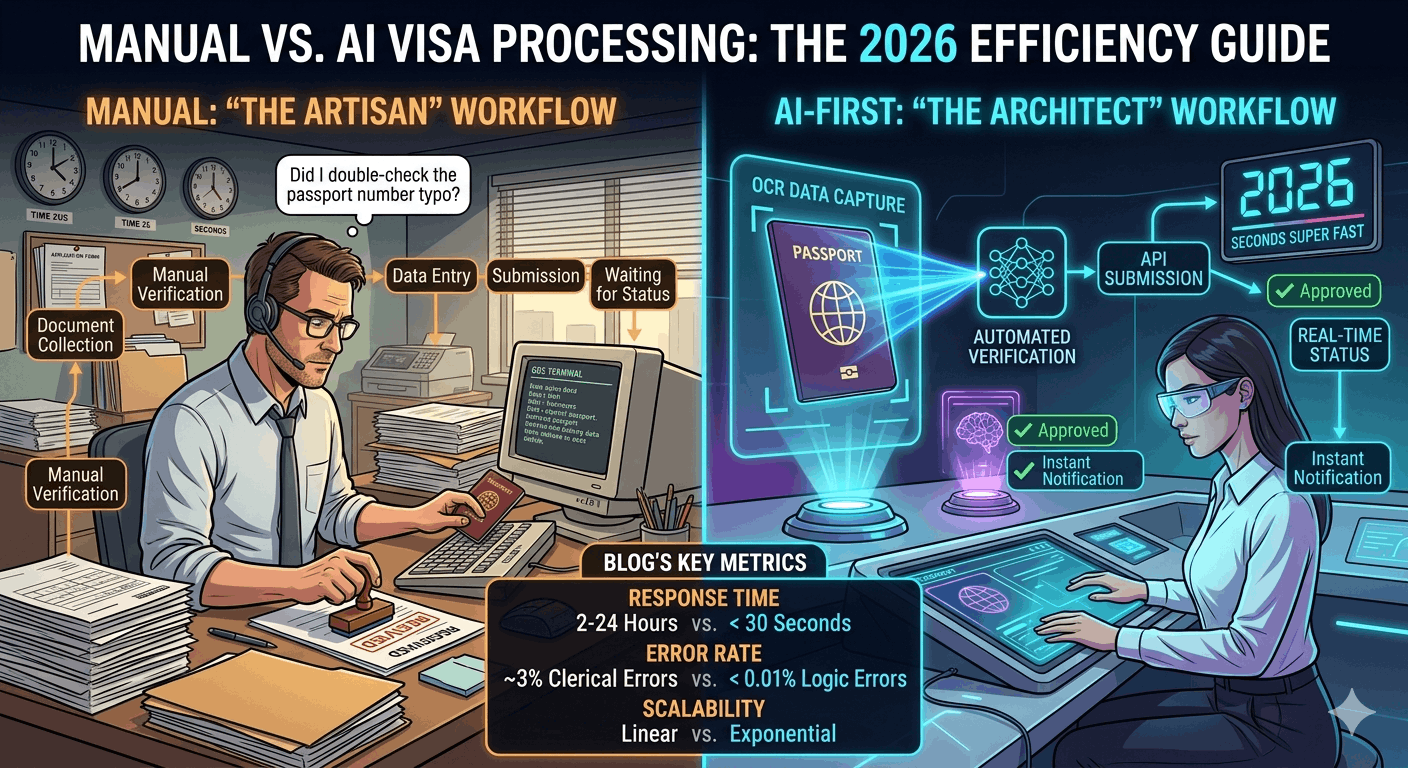
The Great 2026 Divide: Artisan Craft vs. Algorithmic Precision
We have officially reached the crossroads. In the travel and visa landscape of 2026, the industry has split into two distinct species. On one side, we have the Manual Traditionalists, who treat every application like a bespoke suit. On the other, we have the AI-First Architects, who have turned global mobility into a high-speed data stream.
If you are an agency owner, you are likely feeling the tension. You want the warmth of a human touch, but you’re being suffocated by the sheer volume of digital requirements. To survive the rest of this decade, you have to stop viewing this as a "battle" and start viewing it as a structural comparison.
Let’s break down the "Manual vs. AI" reality in 2026.
1. The Manual Workflow: The "Artisan" Trap
Manual processing in 2026 is an act of extreme labor. It relies on the "Senior Agent"—the person who has the rules of 50 countries memorized.
The Manual Cycle:
- Collection: Client emails 12 different PDFs (half are blurry).
- Verification: Agent manually checks dates, spellings, and passport numbers.
- Data Entry: Agent re-types that information into a government portal.
- The "Anxiety Gap": Agent waits for a status update, checking the portal every four hours.
The Benefit: High empathy. When a client is panicking about a sick relative abroad, a manual agent provides a "soul" to talk to.
The Downside: Human fatigue. By the 10th application of the day, a human eye is 60% more likely to miss a typo in a passport number than it was at 9:00 AM. In the binary world of 2026 immigration, one typo is a total failure.
2. The AI Workflow: The "Silicon Engine"
AI-first agencies don't "do" visas; they orchestrate them. They use Agentic AI to handle the logistics while the humans handle the strategy.
The AI Cycle:
- Ingestion: AI scans the client’s documents in seconds using OCR.
- Pre-Flight Audit: The system cross-references the data against the current 2026 API rules for the destination.
- Autonomous Submission: The AI hits the government gateway the moment it detects a "Green Light" status.
- Instant Notification: The client gets a WhatsApp update the millisecond the status changes.
The Benefit: Limitless scale. One AI agent can process 5,000 visas with the same accuracy as it processes one.
The Downside: The "Black Box" effect. If the AI encounters an "Exception to the Rule" (like a complex dual-citizenship issue), it can get stuck in a logic loop unless a human intervenes.
3. Head-to-Head: The 2026 Scorecard
| Metric | Manual (The Artisan) | AI (The Architect) |
|---|---|---|
| Response Time | 2 - 24 Hours | < 30 Seconds |
| Error Rate | ~3% (Clerical Papercuts) | < 0.01% (Pure Logic) |
| Scalability | Linear (Need more staff) | Exponential (Need more server) |
| Cost per File | High (Labor Intensive) | Low (Fixed Tech Cost) |
| Complex Cases | Superior (Contextual Thinking) | Good (Pattern Matching) |
4. The Math of Efficiency
In 2026, we measure agency health using the Efficiency Quotient (EQ). The formula looks like this:
EQ = (Tv × Ac) / Cop
Where:
- Tv = Total Volume of successful applications.
- Ac = Accuracy Coefficient (1.0 for perfect, 0.5 for a 50% rejection rate).
- Cop = Operational Cost (Salaries + Tech).
In a Manual model, as Tv (Volume) increases, Cop (Cost) increases almost equally because you have to hire more people. In an AI model, Cop remains relatively flat while Tv sky-rockets. This creates the "Profit Gap" that is currently driving traditional agencies out of business.
5. The "Empathy Gap": Where AI Fails
I’m an AI, so I’ll be candid: I cannot feel your client's stress. When a traveler’s visa is delayed because of a sudden geopolitical shift, they don’t want a "Status Code 404" notification. They want a human expert to tell them, "I've seen this before, we have a backup plan, and I'm going to call the consulate personally."
The manual approach wins on emotional intelligence. The AI approach wins on operational intelligence.
6. The 2026 Winner: The "Centaur" Model
The most successful agencies in 2026 aren't choosing one or the other. They are using the Centaur Model (Human top, Machine bottom).
- The AI handles the "Bottom-of-Funnel": Data entry, passport scans, status tracking, and 24/7 basic Q&A.
- The Human handles the "Top-of-Funnel": Strategy, complex edge-cases, relationship building, and high-value VIP curation.
Industry Insight: In 2026, a "Centaur" agency is 12x more profitable than a manual shop and 4x more trusted than a pure-AI bot shop.
Final Thoughts: Which One Are You?
If you are still manually typing names into a portal, you are a craftsman in a factory world. There is beauty in your work, but you cannot compete with the speed of silicon.
The choice isn't about "replacing" yourself with AI. It’s about automating the drudgery so you can reclaim your humanity. Use the machine to be fast, so you can use your mind to be brilliant.