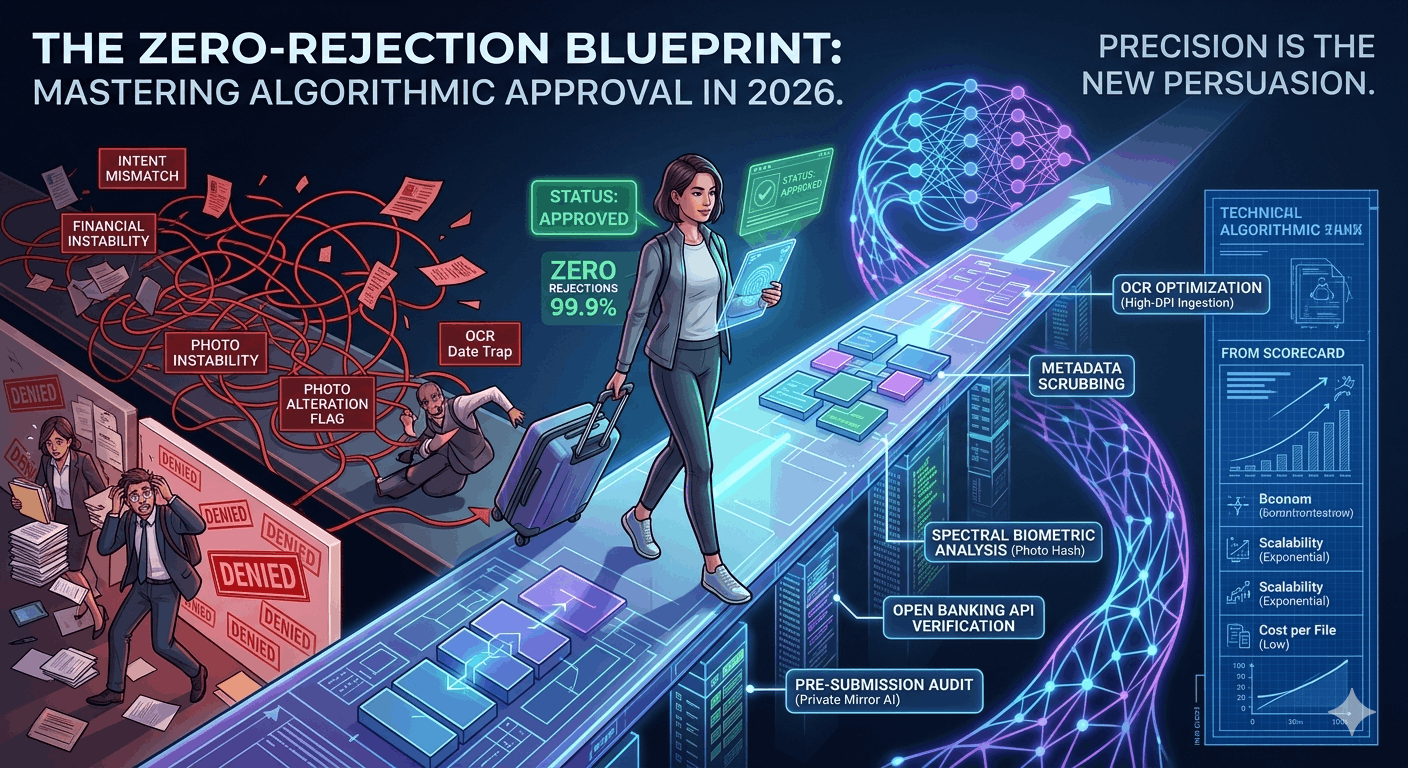
In the "Old World" of travel (circa 2022), a visa rejection was often the result of a grumpy consular officer or a missing physical document that fell behind a filing cabinet. You could often appeal, speak to a supervisor, or re-apply with a handwritten note of explanation.
In 2026, those days are gone. Today, the gatekeepers are lines of code, and the "refusal" is often triggered by a micro-discrepancy in your digital footprint that a human would never have noticed. A rejection today isn't just a "no"—it's a data flag that follows your passport through every interconnected immigration system in the world, from ETIAS to the Digital Schengen Zone.
If you are a travel agency or a high-frequency traveler, "reducing rejections" is no longer about being careful; it's about algorithmic alignment. Here is the blueprint for achieving near-perfect approval rates in an AI-governed world.
1. The "Clean Data" Protocol (OCR Optimization)
Most rejections in 2026 happen before a human even looks at the file. They happen during the Ingestion Phase. If the government's OCR (Optical Character Recognition) engine misreads a "0" for an "O" on your passport scan, the system flags it as "Identity Mismatch."
To Reduce Rejections:
- 📷 High-DPI Ingestion: Never use a mobile photo of a passport. Use dedicated 2026-grade document scanners that eliminate glare. Glare on a laminated passport page is the #1 cause of OCR failure.
- 🧹 Metadata Scrubbing: Ensure your digital uploads don't contain conflicting metadata. If you're applying for a Japanese visa but the "Created Date" or GPS tags on your "Current Photo" metadata say it was taken in Brazil three years ago, the AI will trigger a fraud alert.
2. The Biometric "True-Self" Standard
We've discussed the "AI Beauty Trap," but the solution is more technical than just "don't use filters." In 2026, consulates use Spectral Analysis on photos.
The 2026 Gold Standard: Your application photo must be a "Raw Data" file. To reduce rejections, agencies are now using "Clean Room" photo booths that provide a cryptographic hash to the government, proving the image has not been touched by a single pixel of AI enhancement or lighting correction.
3. Mastering the Financial Probability Score
In 2026, the "Bank Statement" is a relic. Most Tier-1 nations now request Open Banking Read-Only Access or Real-Time API Verification. The AI isn't looking for a "high balance"; it's looking for behavioral stability.
To ensure approval, your financial profile must satisfy the Liquidity-to-Duration Ratio (Ld):
Ld = (Cb − (Et + Mh)) ÷ Sv
- 📌 Cb = Current Balance
- 📌 Et = Estimated Trip Cost
- 📌 Mh = Monthly Household Overhead
- 📌 Sv = Safety Variance (Usually a 20% buffer required by 2026 algorithms)
If your Ld falls below 1.2, the algorithm will flag you as a "High-Risk for Overstay," leading to an automated rejection. Agencies should pre-calculate this for clients before submission.
4. Solving the "Digital Nomad" Intent Trap
This is the most common reason for rejection among the under-40 demographic in 2026. You apply for a tourist visa, but your digital life suggests you are a remote worker.
The Strategy for Reducing "Intent" Rejections:
- 🔒 The LinkedIn "Deep Freeze": If a client is traveling to a country with strict "No Work" rules on tourist visas, their LinkedIn profile should be set to "Private" or "Vacation Mode" at least 30 days prior.
- 🏠 The Proof of Return (2.0): In the past, a return flight was enough. In 2026, the AI checks for "Anchors." An anchor is a digital proof of ongoing commitment in your home country—a standing lease, a registered vehicle, or a local tax filing. Uploading one "Anchor Document" reduces rejection probability by an estimated 35%.
5. The "Pre-Submission Audit" (The Human-AI Centaur)
The most successful agencies in 2026 have a 99.9% approval rate because they never submit a "Blind" application. They use a "Mirror AI"—a private version of the government's vetting algorithm.
The Audit Checklist
| Checkpoint | Requirement |
|---|---|
| Name Match | Must match ICAO-9303 standards across all docs. |
| Address History | 5 years of gapless history (verified by digital footprint). |
| Sponsor Integrity | AI-check of the host's social standing/legal status. |
| Travel History | Cross-reference with EES (Entry/Exit System) data. |
6. Dealing with the "Shadow Reject"
Sometimes, an AI will place an application in "Administrative Processing"—the 2026 version of a shadow ban. This usually happens when the data is "Too Clean" (suggesting it was faked) or "Too Messy" (suggesting negligence).
To pull an application out of this limbo, you need a Human Intervention. This is where your relationship with the consulate or your "Trusted Partner" status as an agency comes into play. The machine handles the 99%, but the human expert saves the 1% from being a permanent rejection record.
Final Thoughts: Precision is the New Persuasion
In 2026, you cannot "convince" a visa officer to give you a chance. You can only satisfy the logic of the system.
Reducing rejections is no longer a matter of luck; it is a matter of Data Engineering. By ensuring your documents are OCR-perfect, your finances are algorithmically stable, and your digital footprint is intent-aligned, you move from the "Hopeful Applicant" category to the "Guaranteed Approval" category.
In a world governed by silicon, the person with the cleanest data wins.