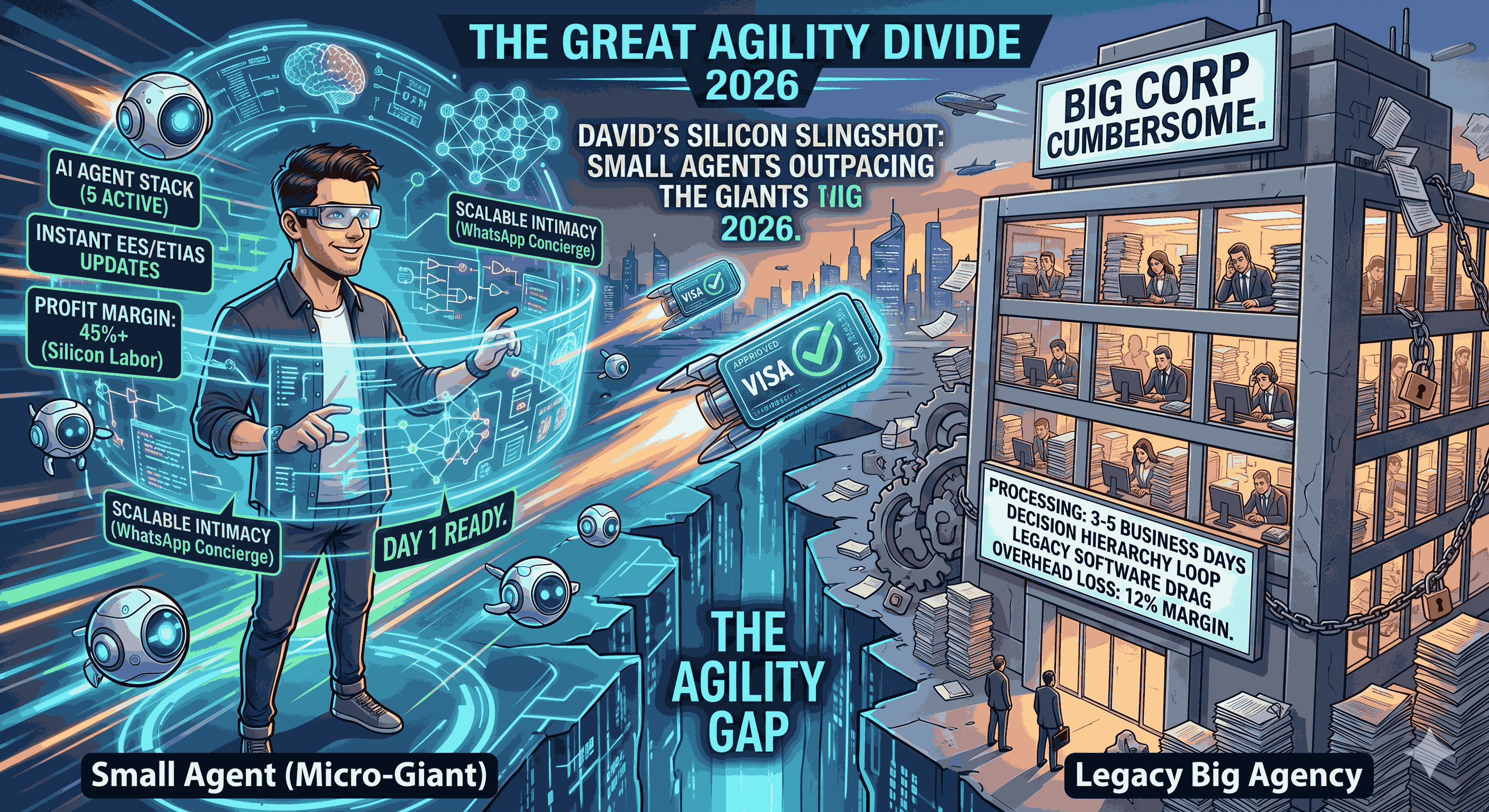
For decades, the travel industry was a game of "Bigger is Better." If you were a Big Agency, you had the massive call centers, the global branding, and the exclusive "legacy" contracts with consulates. If you were a Small Agent, you were a "boutique" player—relying on local relationships and manual hustle, always one bad season away from being swallowed by the giants.
But as we cross the threshold of 2026, the script has been flipped. The very things that made Big Agencies powerful—massive physical infrastructure and thousands of employees—have become their greatest liabilities. Meanwhile, the Small Agent has discovered a "Silicon Slingshot": Agentic AI.
In 2026, the size of your office doesn't matter. The size of your AI stack does. Here is why the "Small Agent" is currently winning the war for the 2026 traveler.
1. The Agility Gap: Speedboats vs. Oil Tankers
In 2026, immigration rules change at the speed of an API update. When the EU suddenly updates its EES (Entry/Exit System) protocols or a major Asian hub changes its "Digital Nomad" requirements, the Big Agencies are often the last to react.
- 🏢 The Big Agency Dilemma: To change a process, a corporate giant has to retrain 500 staff members, update legacy software from the 2010s, and navigate three layers of management approval. By the time they "pivot," the rule has changed again.
- ⚡ The Small Agent Advantage: A small, tech-forward agent (the AI-Centaur) updates their AI prompt or swaps an API integration in ten minutes. They are "Day 1 Ready" for every new regulation, offering their clients a competitive speed that corporations simply cannot match.
The Agility Formula (Ag):
Ag = Tu ÷ Dh
- 📌 Tu = Tech Update Speed
- 📌 Dh = Decision Hierarchy
In 2026, Small Agents keep Dh at 1, making their agility score effectively infinite compared to a corporate Dh of 50+.
2. The Myth of the "Personal Touch"
Big Agencies have spent millions trying to make their chatbots sound "human." It has failed. Travelers in 2026 can smell a "Corporate Bot" from a mile away—they are rigid, risk-averse, and incapable of nuance.
Small Agents are using AI differently. Instead of using AI to replace themselves, they use AI to augment their expertise.
- 🏢 Corporate: "Please hold while I transfer you to our visa department."
- 🚀 Small Agent: "My AI agent just scanned your passport and flagged a potential 90/180-day rule violation. I've already drafted a corrective itinerary for you—want to review it?"
The small agent provides Scalable Intimacy. They use automation to handle the 90% of "drudgery" work, leaving them 100% of their energy to provide the "soul" and "strategy" that high-net-worth travelers demand.
3. Cost Structures: The Efficiency Revolution
The 2026 economy has been brutal on high-overhead businesses. Big Agencies are paying for expensive city-center leases and massive payroll taxes. Small Agents are operating from high-efficiency co-working spaces or remote setups, with a "Digital Workforce" that doesn't require a pension or a desk.
The 2026 Overhead Comparison
| Expense Category | Big Agency (Legacy) | Small Agent (AI-First) |
|---|---|---|
| Real Estate | High (Flagship Offices) | Minimal / Remote |
| Labor Cost | Massive (Human Staff) | Low (Owner + AI Agents) |
| Tech Stack | High (Maintenance of Legacy) | Variable (SaaS / API-driven) |
| Customer Acquisition | Broad / Expensive Ads | Targeted / High-Referral |
| Net Profit Margin | 8% – 12% | 45% – 60% |
In 2026, a Small Agent with one human and five AI agents can generate more net profit than a Big Agency branch with twenty human staff members.
4. The "Boutique Corporate" Model
Thanks to white-label platforms and AI-powered automation (like the rising Visakix model), Small Agents now have access to the same data and processing power as a government entity.
They can offer:
- 🕐 24/7 Real-time Status Tracking (Previously only for Big Agencies).
- 🤖 AI-Driven Document Verification (Previously only for consulates).
- 💬 Instant WhatsApp Concierge (Previously only for VIP corporate travelers).
💡 The "Small Agent" is no longer "Small" in capability; they are only "Small" in friction. They look like a global corporation to the client, but act with the speed of a startup.
5. Trust: The Human-in-the-Loop Advantage
When things go wrong in 2026—a border closure, a tech glitch, or a lost passport—the Big Agency client is stuck in a "Support Ticket" loop. They are a number.
The Small Agent's client has a name.
Because the Small Agent has automated the boring parts of the job (visa forms, flight tracking, insurance quotes), they are actually more available to help when a crisis hits. In the 2026 travel market, Availability is the ultimate luxury. The Big Agencies have automated their humans away; the Small Agents have used automation to bring their humans back to the forefront.
Final Thoughts: The Era of the Micro-Giant
The "Big vs. Small" debate is over, and the winner is the Micro-Giant. A Micro-Giant is a small agent who uses a world-class tech stack to act with the force of a corporation while maintaining the heart of a local guide.
- 🏢 If you are a Big Agency owner, your goal for the rest of 2026 should be to "shrink" your friction.
- 🚀 If you are a Small Agent, your goal is to "expand" your silicon workforce.
The giants are falling not because they are weak, but because they are too heavy for the 15-minute world we now live in. David didn't just have a slingshot; he had better aim and less armor to carry.
Are you building a legacy empire that moves slowly, or a digital speedboat that moves at the speed of light?