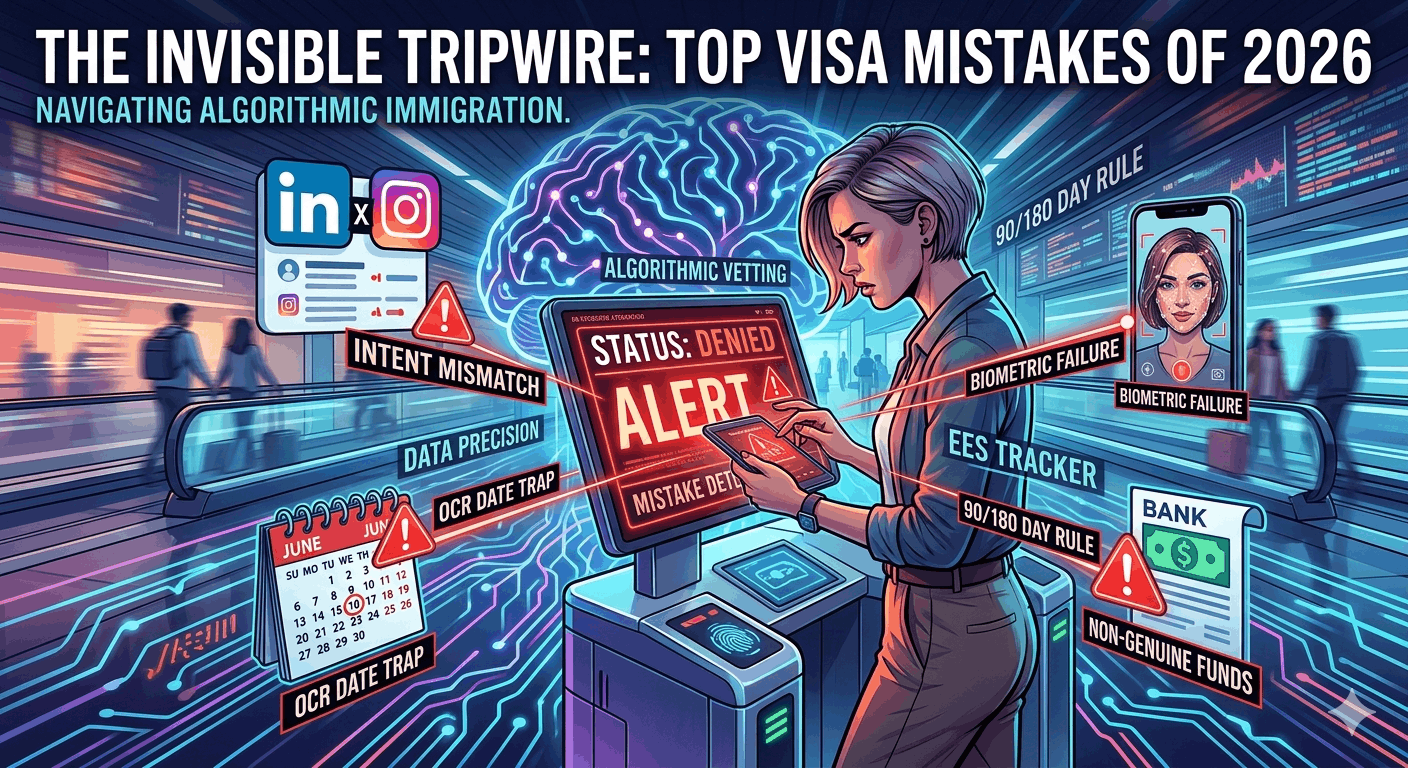
In the travel world of 2026, the "visa interview" is often over before you even walk into the consulate. With the global transition to Algorithmic Immigration, the biggest threats to your travel plans aren't grumpy officials—they are invisible data mismatches.
For agencies and travelers alike, the margin for error has shrunk to near-zero. A single typo that a human might have overlooked in 2022 is now an automatic "Reject" triggered by an AI gatekeeper in milliseconds. If you want to stay mobile in 2026, you need to avoid these high-tech tripwires.
1. The "Social Media Mismatch" (The 2026 Deal-Breaker)
Since mandatory social media vetting became standard for major hubs in 2025, refusals linked to "digital footprints" have surged. In 2026, the AI doesn't just look at what you list—it cross-references your posts against your stated intent.
- 🎯 The Intent Trap: You apply for a "Tourist Visa," but your LinkedIn profile has an "Open to Work" badge or your recent posts discuss "exploring career opportunities in London." To the AI, this is a flag for Intent Fraud.
- 💎 The Lifestyle Discrepancy: If your Instagram shows a lavish lifestyle of private jets and luxury villas, but your bank statement shows a modest balance, the system flags a Financial Credibility Gap.
- 🚩 The "Mass Delete" Red Flag: Mass-deleting your social media history 48 hours before an application is now viewed as "suspicious behavior" by security algorithms.
Key Rule for 2026: Your digital persona must align with your physical paperwork. Integrity is the only currency the algorithm accepts.
2. The "OCR Date Trap": Japan, Germany, and the Midnight Shift
With the rise of 15-minute automated visas, date consistency has become the number one technical reason for rejection. This is particularly brutal for overnight flights.
- 🕛 The Midnight Trap: If you depart Los Angeles at 11:50 PM on June 10th and land in Tokyo on June 12th, your application forms, flight itinerary, and hotel bookings must reflect these date shifts perfectly.
- 📅 The Purpose Window: If your invitation letter for a German business summit says the event starts on the 20th, but your flight lands on the 21st, the AI rejects the application because the "Purpose of Travel" no longer fits the "Timeline of Travel."
The "Consistency Scorecard"
| Mistake | Consequence in 2026 |
|---|---|
| 1-Day Flight Mismatch | Automatic Rejection (Incoherence) |
| AI-Enhanced Photo | Permanent Flag (Document Tampering) |
| Inconsistent First Entry | Annulment at Border (EES/ETIAS rule) |
| "Dummy" Bank PDF | 5-Year Global Ban (Fraud) |
3. The "AI-Beauty" Photo Rejection
In 2026, most travelers use their smartphones to take visa photos. However, the rise of AI "Beautification" tools has become a nightmare for immigration.
- 📸 The "Liveness" Failure: Modern consulates use Liveness Detection to ensure your photo isn't a deepfake. If your phone's "Portrait Mode" or "Face Slimming" feature has been applied, it alters the mathematical distances between your facial features.
- 🚫 The Result: When you arrive at an e-gate, the biometric scanner cannot match your "beautified" visa photo to your real face. This leads to immediate detention and visa annulment.
4. EES/ETIAS Annulment: The Dual Nationality Oversight
For those entering the Schengen Area in 2026, the Entry/Exit System (EES) and ETIAS are now fully linked. A common mistake is applying with one nationality while holding another that has a different risk profile.
- 🛂 Failure to Disclose: If you hold a passport from a visa-exempt country and a visa-required country, failing to disclose both is considered Identity Concealment.
- ⏱️ The "90/180" Math Error: Many travelers still try to "reset" their stay by exiting and re-entering quickly. In 2026, the EES trackers are real-time. If you are even 1 hour over your 90-day limit in the last 180 days, your ETIAS is annulled the moment you scan your passport at the kiosk.
5. Financial "Seasoning" vs. Sudden Deposits
The era of "borrowing money for a week" to show a high bank balance is over. In 2026, most major embassies use Open Banking APIs or AI-driven bank statement analysis.
- 💰 The "Lump Sum" Flag: If a large deposit appears 3 days before you download your statement without a clear source of income, the AI flags it as "Non-Genuine Funds."
- 📊 Stability is King: The algorithm looks for 3 to 6 months of consistent behavior. It calculates your average monthly spend against your trip cost. If the math doesn't add up, the rejection is instant.
How to Bulletproof Your 2026 Application
To navigate this silicon-guarded world, you must move from "filling forms" to "Data Auditing."
- 🤖 Use a Pre-Submission Audit Tool: Never hit "Submit" on a government portal without first running your data through an AI compliance checker to find typos or date shifts.
- 🔍 Audit Your Public Digital Footprint: Use a private browser to search for yourself. If your public LinkedIn or X (Twitter) profile contradicts your trip's purpose, archive the posts months in advance.
- ⏸️ The 10-Minute Rule: After finishing an application, walk away for 10 minutes. Come back and check the Passport Number and Expiry Date one last time. These two fields account for 40% of all technical rejections.
Final Thoughts
In 2026, the visa process is a test of Data Integrity. The system isn't trying to find "bad people"; it's trying to find "inconsistent data." By treating your application with the same precision as a piece of code, you ensure that the doors to the world remain wide open.