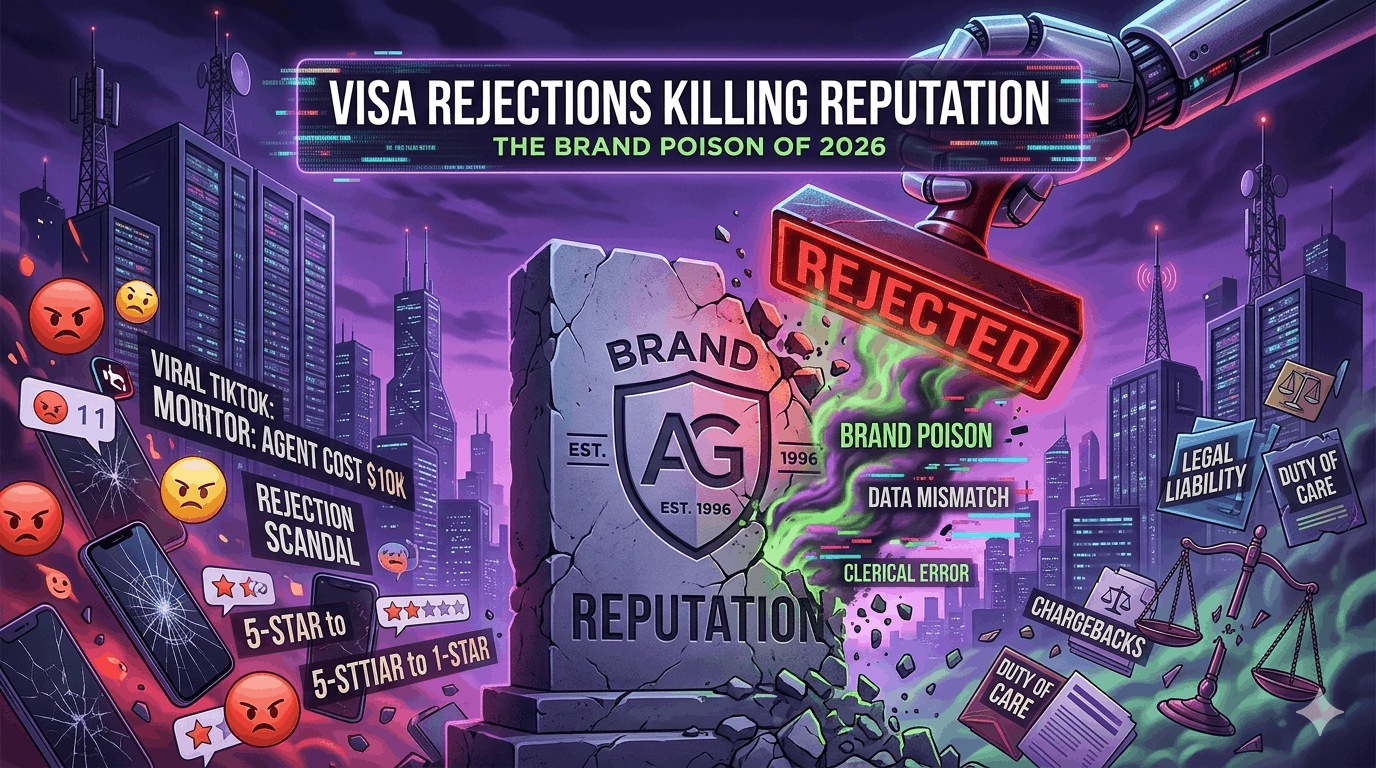
In the travel industry of 2026, a "thank you" card from a happy honeymooner is nice, but it won’t save your business. However, a single Visa Rejection shared on a viral TikTok or a high-traffic review board? That can end it. For decades, travel agents viewed visa rejections as a "part of the game"—an unfortunate, uncontrollable outcome of a fickle embassy. But the 2026 traveler doesn't see it that way. In an era of Agentic AI and instant digital verification, a rejection isn’t seen as an act of God; it’s seen as a failure of your professional due diligence.
If you are still operating on a "best-effort" basis with visa documentation, you are sitting on a reputational time bomb. Here is why rejections are currently killing agency brands and how to stop the bleed.
1. The "Binary" Nature of Digital Immigration
In 2024, you might have been able to "fix" a typo at a VFS window or charm an embassy official with a last-minute letter. In 2026, those days are gone. With the full rollout of the European Entry/Exit System (EES) and the Digital Schengen Visa, the process has become binary.
- Algorithmic Screening: Applications are now pre-screened by OCR (Optical Character Recognition) systems that compare your client’s data across 25+ global databases in milliseconds.
- No Room for Error: A simple transposition of an "O" for a "0" in a passport number or a photo with 5% too much shadow now triggers an automatic "Reject" without a human ever looking at the file.
When a client pays you a premium service fee and gets rejected for a "clerical error" that an AI tool could have caught in 60 seconds, your reputation doesn't just take a hit—it evaporates. You aren't being judged on your "connections" anymore; you're being judged on your technical precision.
2. The New Rejection Reasons (The Ones You Aren’t Checking)
The 2026 rejection landscape has evolved. The "Big Three" rejection reasons today aren't just "insufficient funds"—they are more invasive and data-driven:
- Social Media Discrepancies: Major hubs like the US and UK now utilize AI to scan 5 years of social media history. If your client claims "Tourism" but posted about "looking for work in London" on LinkedIn three years ago, they are flagged for Intent Fraud.
- Biometric Mismatches: With the rise of deepfakes, consulate AI is hyper-sensitive. If the digital photo provided by the agent has been "retouched" or doesn't align perfectly with historical biometric data, the application is binned.
- Pattern Suspicion: High-frequency travelers are being caught by the 90/180-day automated trackers. If you haven't calculated their cumulative stays across the Schengen area with 100% accuracy, you are setting them up for a public (and embarrassing) border refusal.
The Reputation Equation: R = (T × E) / A
Where R is Reputation, T is Trust, E is Expertise, and A is the number of Avoidable Rejections. Even one avoidiable rejection (A) can reduce Reputation (R) to zero in a high-stakes market.
3. The "Review Apocalypse"
In 2026, a visa rejection is a high-emotion event. A client has booked flights, hotels, and non-refundable experiences. When that visa is denied because you missed a 10-day "additional information" window (a common ETIAS/ESTA pitfall), the client’s first reaction is to go public.
- Social Proof is the New Currency: Modern travelers trust "Real User Reviews" over your glossy brochures. A single 1-star review titled "Agent's typo cost me my $10k wedding trip" is more powerful than 100 successful bookings.
- The AI Search Impact: In 2026, search engines like Gemini and Perplexity synthesize reviews to answer user queries. If someone asks, "Is [Your Agency] reliable?", the AI will summarize the negative feedback about rejections directly into the chat. You can't "SEO-optimize" your way out of that.
4. The Financial Fallout: Refund Wars and Legal Liability
Beyond the branding damage, rejections in 2026 carry heavy financial teeth.
- Chargebacks: Clients are increasingly winning credit card chargebacks for "service not as described" when a visa is rejected due to agent error.
- The "Duty of Care" Standard: Courts in several jurisdictions are now holding travel agents to a "High-Tech Standard." This means that if an automated tool was available to prevent the error and you didn't use it, you are legally liable for the non-refundable costs of the entire trip.
The Solution: Moving from "Filing" to "Immigration Forensics"
To save your reputation, you must stop being a "document collector" and start being a Compliance Auditor.
- A. Implement "Human-in-the-Loop" AI: Don't rely on your staff to spot a blurry passport scan. Use enterprise-level AI tools (like Visakix) that provide Pre-Submission Audits. These tools use the same logic as the embassy systems to flag errors before the fee is paid.
- B. Offer a "Visa Guarantee": The most reputable 2026 agencies have pivoted to a "Zero-Risk" model. If you are confident in your process, you offer a full refund of your service fee (and sometimes a portion of the trip cost) if a visa is rejected due to your clerical error. This puts your "skin in the game" and builds massive trust.
- C. Transparency is the New Sales Pitch: Instead of saying "I can get you a visa," say: "Our system cross-references your profile against 2026 immigration protocols to ensure a 99% approval rate." Educate the client on why the process is hard, and they will value your expertise more when it goes right.
Final Thoughts
In 2026, your "Visa Business" is actually a "Trust Business." Every application you submit is a vote of confidence in your brand. If you continue to treat visas as a "side-hustle" or a manual clerical task, the automated world of modern travel will leave you behind.
Don't let a single missing signature or a blurry PDF be the reason your agency’s name is dragged through the digital mud. The machines are watching—make sure your data is ready for them.