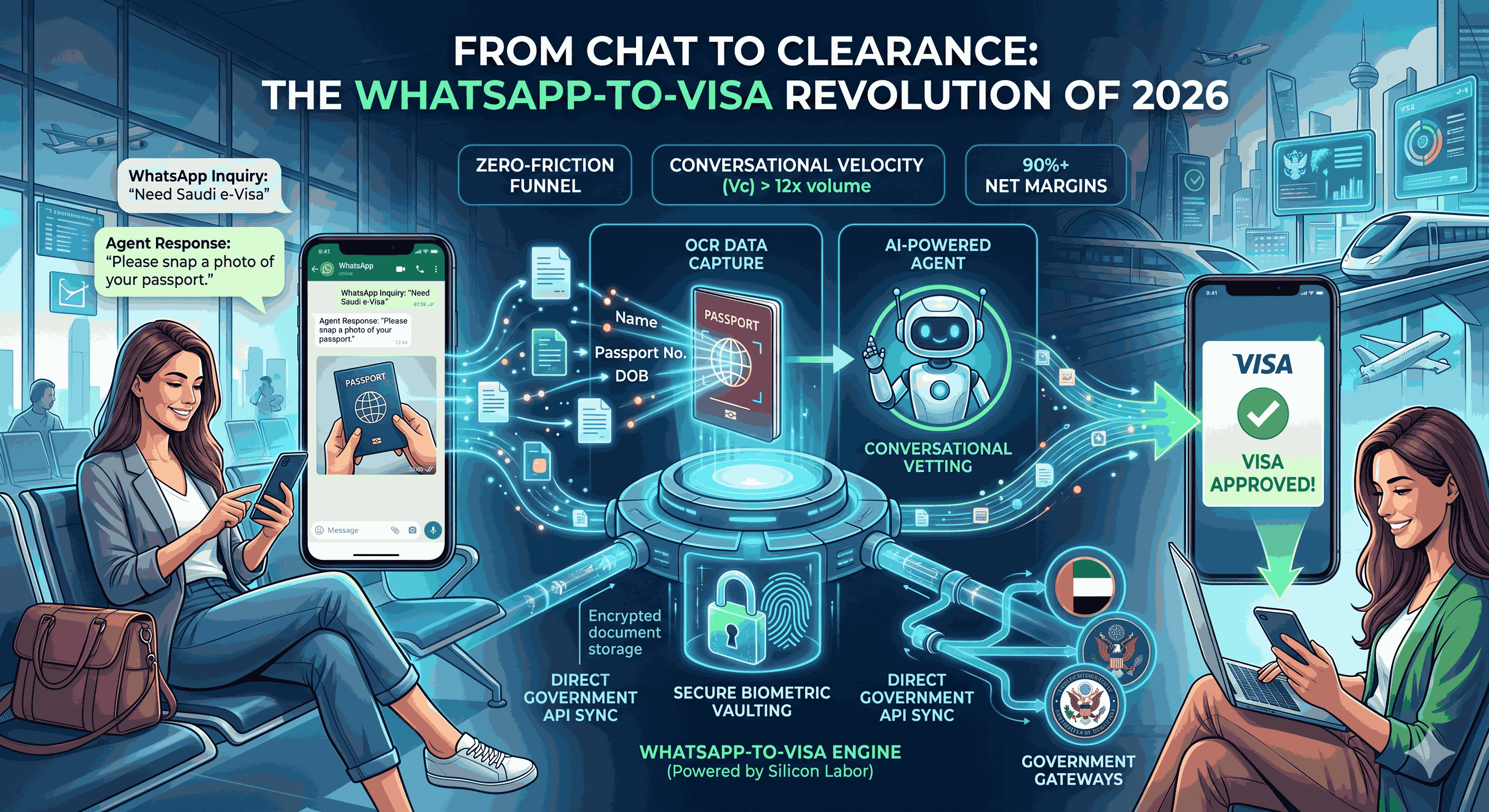
In 2026, the most powerful tool in a travel agent's arsenal isn't a complex GDS terminal or a sleek desktop portal—it is the green icon sitting on billions of smartphones. The "Application Form" is dying. In its place, we are seeing the rise of Conversational Immigration, a world where a traveler can secure a visa by simply texting their passport photo to their agent's WhatsApp.
For agencies, this isn't just a convenience; it’s an Efficiency Explosion. By moving from web-based forms to WhatsApp automation, the "Micro-Giant" agencies of 2026 are capturing leads and closing sales before the big corporate competitors even send their first "Thank you for your inquiry" email.
1. The Frictionless Funnel: Meeting the Client Where They Live
In the legacy travel model, a visa inquiry usually meant sending a link to a client, who then had to find a desktop, remember a password, and navigate a clunky web form. This is where most sales died.
In 2026, the Conversational Interface removes every barrier.
- 🗣️ The Lead: A client asks about a Saudi e-visa via WhatsApp.
- 📥 The Ingestion: Your AI-powered WhatsApp agent responds instantly, asking for a quick photo of the passport.
- ✨ The Magic: Behind the scenes, Silicon Labor takes over—OCR (Optical Character Recognition) extracts the data, runs a real-time eligibility audit against the latest EES/ETIAS rules, and pre-fills the application.
The client never leaves the chat. The friction is zero.
2. The Tech Stack: How WhatsApp Becomes a "Visa Engine"
To turn a chat app into a high-margin processing center, the "Centaur Model" of 2026 combines human oversight with a specialized tech stack.
- 🤖 Agentic AI Nodes: These aren't simple chatbots; they are autonomous agents capable of identifying document types and flagging "OCR Date Traps" before they reach the government.
- 🔌 White-Label API Sync: The WhatsApp interface is linked directly to your Branded Visa System, which pushes the data straight to government gateways.
- 🔒 Secure Vaulting: In 2026, document security is paramount. Your system encrypts the passport photo within the chat and moves it to a secure biometric vault, ensuring no sensitive data "lives" on the phone.
3. The Math of WhatsApp Efficiency
Why are small agents using WhatsApp automation seeing 90%+ net margins? It comes down to the Conversational Velocity (Vc):
Vc = La ÷ (Ht × Fr)
- 📌 La = Leads Accepted
- 📌 Ht = Human Touch-Time (Minutes)
- 📌 Fr = Friction Ratio (Redirections to external sites)
In a WhatsApp-to-Visa system, Fr is 1.0 (no redirection) and Ht drops from 20 minutes of data entry to 30 seconds of final verification. This allows one agent to process 12x more volume than a manual workflow.
4. Solving the "Document Nightmare" via OCR
The #1 reason for visa rejections in 2026 remains "Identity Mismatch". When clients type their own data into web forms, they make mistakes. When they send a photo on WhatsApp, the OCR Data Capture does the heavy lifting.
| Feature | Manual Entry (2022) | WhatsApp OCR (2026) |
|---|---|---|
| Data Accuracy | ~94% (Human Error) | >99.9% (Algorithmic Precision) |
| Submission Time | 2-24 Hours | < 30 Seconds |
| Client Effort | High (Form-Filling) | Minimal (Snapshot) |
| Scalability | Linear (Need more staff) | Exponential (Silicon Labor) |
5. The "Human-in-the-Loop" Advantage
The true power of the 2026 WhatsApp model is that it doesn't replace the agent; it supercharges them.
When the AI detects a complex issue—like a potential "Intent Mismatch" based on a client's travel history—it doesn't just reject the application. It pings the human agent within the WhatsApp thread. The agent can then step in, provide expert advice, and secure the "Zero-Rejection Blueprint" for the client.
This is the "Centaur" advantage: machine speed for the data, human empathy for the strategy.
Final Thoughts: The Inbox is the New Border
In the 2026 economy, the agency that wins is the one that is the easiest to talk to. By automating the visa process directly through WhatsApp, you turn your agency into a "Micro-Giant"—a business with the heart of a local boutique and the processing power of a global corporation.
Stop asking your clients to fill out forms. Start asking them to send a photo. In 2026, the future of travel isn't a website; it’s a conversation.