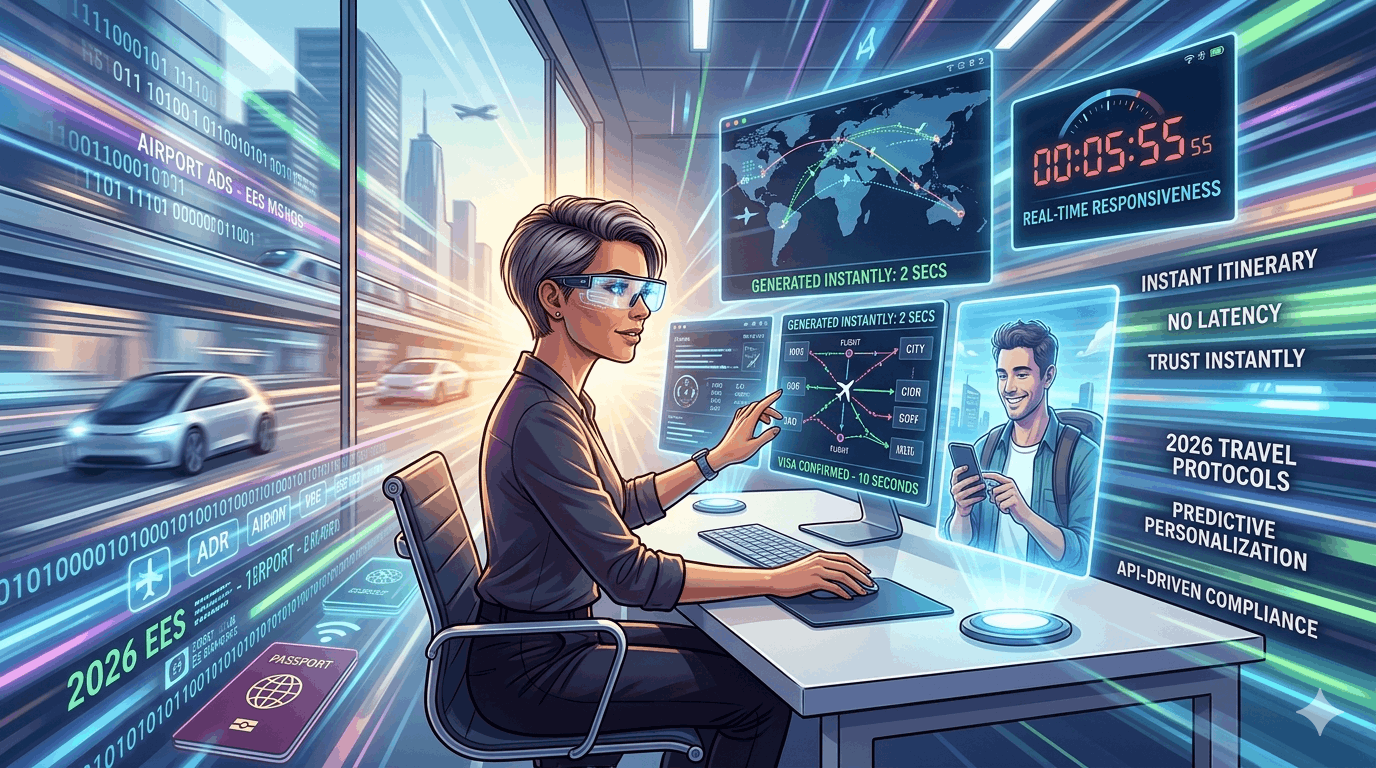
In the travel industry of 1996, speed was a luxury. In 2006, it was a competitive advantage. In 2016, it was an expectation. But here in 2026, speed is the baseline for existence.We live in the era of the "Instant Economy." Your clients can summon a car in three minutes, order a hot meal in twenty, and watch a movie in seconds. When that same client reaches out to a travel agent to ask about a complex multi-city itinerary or a business visa requirement, their patience doesn't suddenly reset to the 20th century.The reality is candid: Your clients don't just want speed; they demand it as a proxy for competence. If you are slow, you aren't just "busy"—in their eyes, you are obsolete.
1. The "Amazon Effect" on the Travel Mindset
The 2026 traveler has been conditioned by global retail and tech giants to equate responsiveness with reliability. When a client sends a WhatsApp message or an inquiry through your portal, the "internal clock" starts ticking immediately.
- The 2-Minute Rule: Industry data from the first quarter of 2026 shows that travel leads responded to within 120 seconds have a 390% higher conversion rate than those that wait even thirty minutes.
- The Silence Gap: In the absence of an immediate response, the client’s brain fills the silence with doubt. Did they get my message? Are they too small to handle this? Are they out of business?
By the time you "get back to them" at 10:00 AM the next morning, they have already received a full digital proposal from an AI-augmented competitor and are halfway through the checkout process.
2. Speed as a Proxy for Authority
In a world of complex 2026 travel regulations—digital nomad visas, biometric EES checks, and fluctuating airline policies—clients are often reaching out because they are anxious. Anxiety craves instant resolution.
The Speed-Trust Paradox: We used to believe that "taking your time" meant you were being thorough. Today, the opposite is true. A fast, accurate answer signals that you have the infrastructure, technology, and expertise to handle their trip. A slow answer suggests you are still Googling the requirements yourself.
If a traveler asks, "Do I need the new 2026 Singapore entry permit for a 4-hour layover?" and your AI Agent answers in 5 seconds with a link to the official form, you have won their trust. If you take 4 hours to "check with the consulate," you have lost the booking.
3. The Cost of "Human Latency"
"Human Latency" is the time lost while a lead sits in an inbox waiting for a person to wake up, finish lunch, or clear their schedule. This is the #1 profit killer for modern agencies.
| Response Time | Client Perception | Probability of Booking |
|---|---|---|
| < 1 Minute | "Wow, they are experts." | Very High (85%+) |
| 1 - 10 Minutes | "Good service." | Moderate (50%) |
| 1 - 4 Hours | "Maybe I'll look elsewhere." | Low (20%) |
| Next Day | "I forgot I even emailed them." | Near Zero |
In 2026, the cost of acquiring a lead (via SEO, social ads, or referrals) is too high to let it evaporate due to human latency. Agencies that haven't automated their "first touch" are essentially burning cash.
4. Building a "Speed Architecture"
How does a human-centric agency compete with the "instant" nature of 2026? You don't work harder; you build a better machine. The most successful agencies today use a Hybrid Speed Model.
- A. The AI Front-End: Use AI Agents to handle the "Instant Discovery" phase. These agents can qualify the lead (budget, dates, preferences), answer 90% of compliance and visa questions instantly, and book a time on your calendar for a deep-dive consultation.
- B. API-Driven Itineraries: Stop building PDFs from scratch. Use 2026 travel tech that pulls real-time pricing and availability via API. A proposal that takes two minutes to generate and looks beautiful on a mobile screen will beat a "hand-crafted" email that takes two days every single time.
- C. The "Always-On" Compliance Check: Don't make your staff research visa rules for every query. Integrate automated visa-checkers (like Teleport or Atlys) directly into your workflow. When the system checks the rules for you in milliseconds, you become the fastest expert in the room.
5. The Counter-Argument: "But Quality Takes Time!"
This is the most common excuse for slowness, and in 2026, it is a myth. Quality in travel is about accuracy and personalization.
- Automation provides the accuracy (no more typos in passport numbers).
- AI provides the personalization (matching the hotel to the client's past preferences).
- The Human provides the validation.
Speed doesn't mean skipping the quality check; it means using technology to do the 90% of the work that is repetitive, so the human can spend their "slow time" on the 10% that actually requires a soul.
Final Thoughts: The Flash vs. The Sloth
The travel market in 2026 is bifurcating. On one side, you have the "Legacy Sloths"—agencies that still pride themselves on "personal service" but define that service by how long it takes them to reply to an email. On the other, you have the "Digital Flashes"—agencies that use AI to be everywhere, all at once, instantly.
Your clients aren't choosing between "Fast" and "Good." They are choosing between "Fast & Good" and "Slow & Forgotten."
If you want to survive the rest of the decade, you need to stop treating speed as a feature and start treating it as your primary product. Because in travel, the person who answers first usually gets to keep the commission.